
5083 Aluminum Alloy Plate Questions Seen in Tanker Truck Discussions
Aluminum tanker fabricators and fleet operators increasingly ask detailed questions about 5083 aluminum alloy plate because tank weight, weld quality, corrosion resistance, and service life are closely connected. The following questions reflect recent English-language Q&A discussion themes around aluminum tanker plate selection and aluminum tank truck manufacturing.

| Tanker Requirement | Why It Matters for 5083 Plate | What to Confirm Before Ordering |
|---|---|---|
| Shell strength | Affects pressure cycling and road vibration resistance | Temper, thickness, tensile data |
| Weld performance | Welds are critical zones on tanker shells and bulkheads | Filler wire, weld procedure, post-weld properties |
| Corrosion resistance | Helps protect the tank exterior and product-contact surfaces | Cargo medium, cleaning chemicals, operating climate |
| Flatness | Supports rolling, forming, and accurate longitudinal welding | Plate tolerances and surface condition |
1. Is 5083 aluminum alloy plate suitable for a fuel tanker body?
Yes, 5083 aluminum alloy plate is widely suitable for fuel tanker shells, compartments, bulkheads, and structural components when the vehicle design, thickness, and welding procedure match the intended cargo and applicable transport regulations. Its main advantages are relatively high strength among non-heat-treatable aluminum alloys, strong resistance to marine and industrial atmospheres, and dependable weldability.
For a road tanker, the practical benefit is weight reduction. An aluminum tank can carry more payload than a comparable steel design while maintaining robust structural performance. However, 5083 is not automatically the best option for every tank component. The shell, end caps, baffles, walkways, supports, and piping brackets may require different alloys or tempers because they face different forming loads and stress conditions.
When requesting 5083 aluminum plate, specify whether the material will be used for a rolled cylindrical shell, dished end, internal bulkhead, or chassis-related part. This helps the mill recommend a suitable temper and dimensional tolerance rather than supplying a general-purpose plate.
2. Which temper of 5083 plate is commonly used for aluminum tanker manufacturing?
H111 and H116 are frequently considered for tanker-related applications, while H321 may be selected where stable properties and corrosion performance are especially important. The correct choice depends on forming severity, design stress, and the service environment.
H111 has undergone a limited amount of strain hardening and can be useful where forming is important. H116 and H321 are more commonly discussed for demanding corrosion environments because they are associated with improved resistance to exfoliation corrosion in marine-type conditions. A tanker operating in humid coastal areas, on winter salt-treated roads, or near chemical processing sites may benefit from a temper selected with corrosion exposure in mind.
A higher-strength temper is not always preferable. During tank rolling and head forming, excessive hardness can increase springback or complicate forming. Fabricators should compare the required bend radius and final shell geometry with the plate temper, not merely select the highest listed tensile strength.
3. What thickness of 5083 aluminum plate should be used for a tanker shell?
There is no universal thickness because tanker shell design depends on tank diameter, compartment arrangement, cargo density, operating pressure, support spacing, rollover standards, and local regulations. In many aluminum road tanker projects, shell plate may fall roughly within the 4 mm to 7 mm range, but this is a planning reference rather than a design approval.
Thicker plate can improve dent resistance and stiffness, but it also adds weight and may reduce the payload advantage of an aluminum tanker. Thin plate can lower empty vehicle weight, yet it requires careful attention to weld distortion, support placement, and baffle design. A large-diameter tank carrying dense liquid can need a different shell calculation from a smaller tank carrying lower-density fuel.
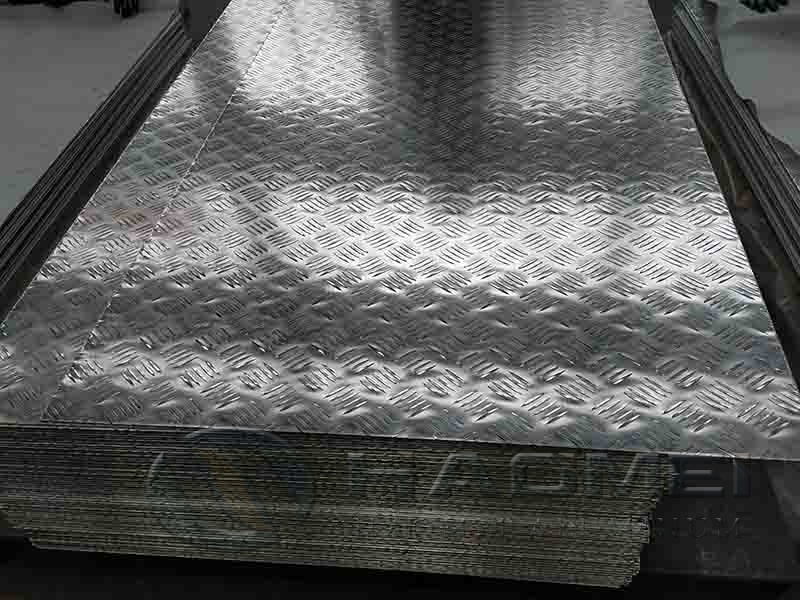
The plate width also deserves attention. Wider plate can reduce the number of longitudinal welds, which may simplify fabrication and lower the number of inspection points. On the other hand, handling equipment, rolling machine capacity, and transport limitations can influence the most economical width.
4. Does welding reduce the strength of 5083 aluminum tanker plate?
Welding can reduce strength in the heat-affected zone because the strain-hardened condition adjacent to the weld is partially softened by heat. This is an expected engineering consideration for 5xxx-series aluminum alloys, not necessarily a defect. Tanker designers account for it by using appropriate joint geometry, weld size, plate thickness, and allowable stress values.
Good welding results depend on more than the plate itself. Clean edges, controlled oxide removal, dry filler wire, correct shielding gas flow, and stable parameters all affect weld integrity. Common filler choices for 5083 fabrication include 5183 and 5356, but the selected filler should be validated against the cargo, temperature range, corrosion exposure, and required mechanical properties.
For tanker shells, qualified weld procedures and non-destructive testing are particularly important around longitudinal seams, circumferential seams, bulkhead attachments, manhole reinforcements, and discharge fittings. A visually smooth weld is not enough evidence of suitability; the fabrication process should control porosity, lack of fusion, distortion, and contamination.
5. Should I choose 5083 or 5454 aluminum plate for a tank truck?
Both alloys are used in transportation equipment, but they serve somewhat different selection priorities. 5083 generally offers higher strength and excellent corrosion resistance, making it attractive for demanding tanker shells and structures. 5454 aluminum plate is often considered where elevated-temperature performance, formability, and certain tanker service requirements are important.
| Comparison Point | 5083 Aluminum Alloy Plate | 5454 Aluminum Plate |
|---|---|---|
| Relative strength | Generally higher | Moderate, often favored for formed tanker parts |
| Corrosion resistance | Excellent in marine and industrial environments | Very good, with strong elevated-temperature stability |
| Typical tanker use | Shells, bulkheads, structural tank sections | Tank bodies and formed components, depending on specification |
| Selection priority | Strength-to-weight and corrosion resistance | Formability and heat-related service considerations |
The cargo type should influence the final decision. Petroleum products, edible liquids, chemicals, cleaning agents, and temperature-controlled products can impose different material compatibility requirements. Ask for mill test certificates showing alloy, temper, dimensions, mechanical properties, and chemical composition. For critical tank applications, confirm the material against the vehicle design standard and the cargo transport rules used in the operating region.